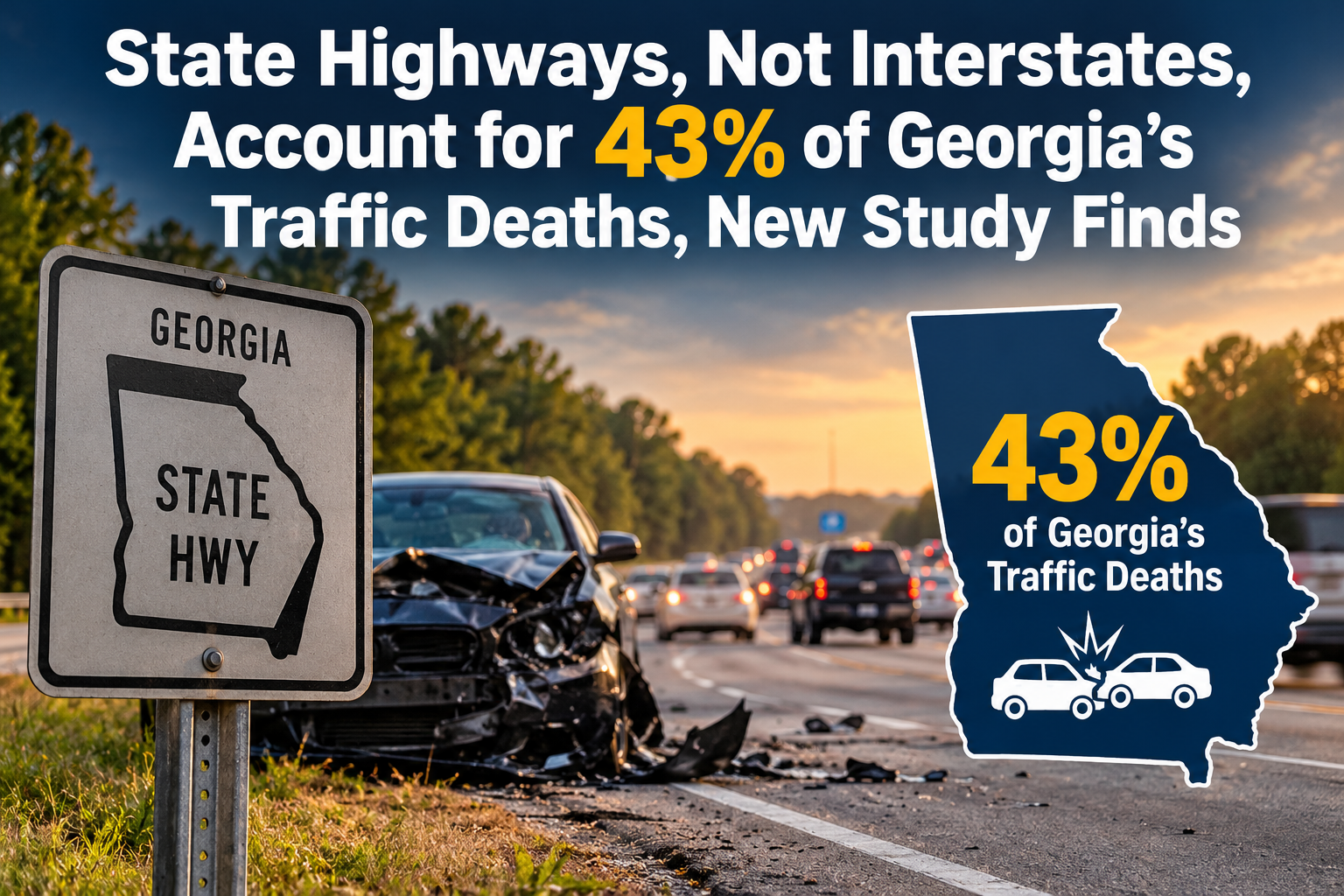
State highways accounted for 43.3% of all traffic deaths in Georgia in 2024, more than three times the 14.1% share on the state’s interstates, according to a new analysis by Van Sant Law. Of the 1,403 people killed on Georgia roads that year, 607 died on state highways and 198 died on interstates. Adding U.S. highways, Georgia’s major road network accounted for 883 deaths, nearly 63% of the statewide total. The analysis is based on data from the National Highway Traffic Safety Administration’s Fatality Analysis Reporting System and Crash Data Analysis Tool. It finds that the roads behind Georgia’s death toll differ sharply in who uses them and which vehicles are involved when crashes turn deadly.
Deadliest Roads in Georgia
I-75 topped the list of Georgia’s deadliest individual roads, with 69 deaths in 59 fatal crashes. I-20 ranked second with 47 deaths in 41 crashes, followed by I-85 with 29 and I-285 with 19. The rest of the top 10 were state highways: SR-1 recorded 18 deaths, SR-3 and SR-20 recorded 16 each, SR-520 had 15, SR-53 had 14, and SR-5 had 12. These state routes run through metro suburbs, small towns, and rural areas, where conditions can change quickly from one mile to the next. Some sections have two way traffic, limited shoulders, fewer barriers between opposing vehicles, and long stretches traveled at higher speeds.
The Vehicle Types Involved in Fatal Crashes
The vehicle data shows how different these corridors are. Georgia’s 1,312 fatal crashes in 2024 involved 1,983 vehicles. Passenger cars appeared most often at 645, followed by 493 SUVs and 331 pickups. Combined, SUVs and pickups totaled 824 vehicles, well above the number of passenger cars. Large trucks accounted for 189 vehicles and motorcycles for 187, but those statewide figures shift dramatically from road to road.
On I-75, large trucks were involved in 39% of fatal crashes, the highest share among Georgia’s 10 deadliest roads, and those crashes were linked to 32 deaths. Passenger cars appeared in 49.2% of I-75’s fatal crashes and SUVs in 33.9%. That heavy truck presence reflects I-75’s role as one of the Southeast’s main north to south freight routes. It carries commercial traffic across the state while its metro Atlanta sections handle massive commuter volumes, an estimated 419,000 vehicles per day at the busiest point. I-20 showed a similar but smaller commercial presence, with large trucks in 34.1% of its fatal crashes. Truck involvement was not limited to interstates, though. SR-5 ranked tenth in total deaths but recorded a 33.3% large truck involvement rate.
Motorcycles tell a completely different story. They were involved in just 1.7% of fatal crashes on I-75, but that share jumped to 25% on both SR-3 and SR-5, meaning one in four deadly crashes on those roads involved a motorcycle. SR-3 also had no fatal crashes involving a large truck, a sharp contrast with I-75.
Several state highways showed a strong presence of pickups and SUVs. Pickups were involved in 46.2% of fatal crashes on SR-520, more than any other vehicle type on that road. On SR-53, SUVs were involved in half of all fatal crashes. SR-3 combined a relatively high pickup share with the lowest SUV involvement of any road in the top 10.
Conclusion
The analysis concludes that looking at death totals alone can make Georgia’s deadliest roads seem more alike than they are. The four interstates carry a heavy mix of commuter and freight traffic, while pickups, SUVs, and motorcycles show up far more often on several state routes. Those differences suggest that making Georgia’s highways safer will take approaches tailored to each corridor rather than a single statewide fix.