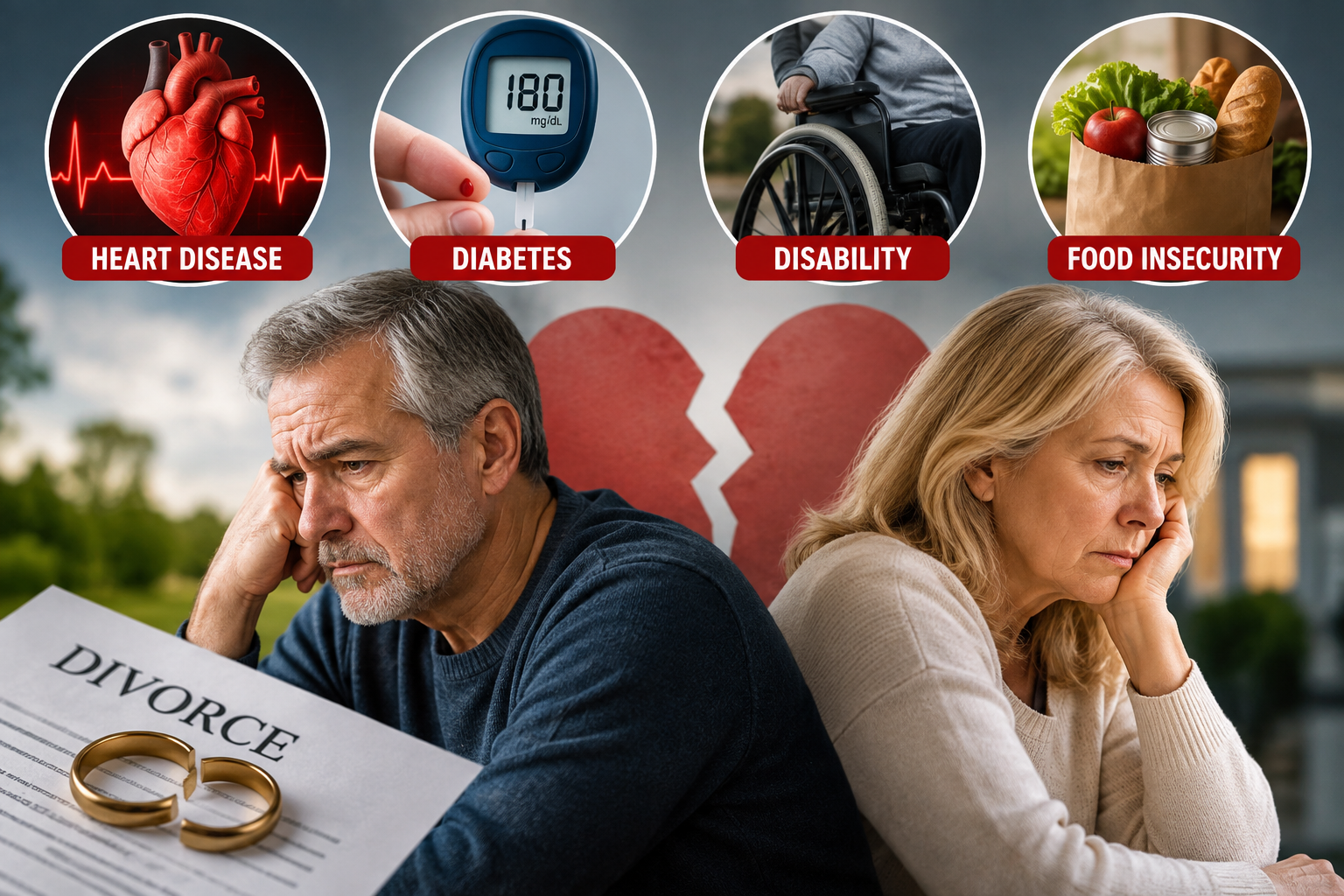
The effects of divorce after 50 do not end in the courtroom, according to a new study from Envision Family Law. The firm reviewed research on gray divorce and found that people who divorce later in life face measurable declines in physical health, food security, and social connection, and that some of those effects grow worse over time. The findings come as adults aged 50 and older make up 36% of all U.S. divorces, up from under 9% in 1990, even as the national divorce rate sits at its lowest point in more than five decades.
A 2024 study drawing on nearly two decades of Health and Retirement Study data compared 736 divorced or separated adults over 50 with 15,839 people in stable partnerships, including 689 closely matched pairs. Divorced older adults faced an average 4.4% increase in the risk of food insecurity. That risk rose to 7.3% in the year of the divorce, 9.5% after two years, 10.3% after four years, and 11.1% after six or more years, showing that financial strain can deepen long after a divorce is final. Women were hit hardest: their food insecurity risk was 7.7% higher than men’s in the year of the divorce and 10.4% higher after six years.
The same study found that physical limitations increase over time. Divorced older adults had an average 5.7% rise in limits on daily activities, reaching 7.9% after four years and 8.7% after six. Depression symptoms rose an average of 3.5% but generally returned to baseline within two years. That suggests divorce acts as an acute emotional shock rather than a lasting psychological wound, while the physical and financial effects keep building.
A separate 2024 meta-analysis of 94 studies covering more than 1.38 million people found that divorced adults were more likely than married peers to have diabetes (18%), joint conditions (24%), cardiovascular disease (24%), and cerebrovascular disease (31%). Divorced people were also 20% more likely to report poor overall health and 34% more likely to report physical problems. Risk was highest among people with less education, the unemployed, those without children, heavy drinkers, the physically inactive, and people with higher body weight, and women again faced greater overall risk than men. Divorce ranks second on the Holmes-Rahe Stress Inventory. Chronic stress is associated with hypertension, insomnia, heart disease, obesity, and weakened immunity.
Isolation is another serious risk. Among nearly 1,000 adults who divorced after 50, drawn from a panel of 29,700 Americans, more than a quarter reported feeling socially isolated and nearly one in three said they lack companionship, with women reporting this 5% more often than men. Loneliness was most common among people in their 50s and early 60s, the ages where gray divorce is rising fastest, and among those earning under $60,000 a year. Socially isolated older adults are around eight times more likely to report fair or poor mental health and more than twice as likely to report poor physical health. Living alone, a common result of gray divorce, is one of the main predictors of those outcomes.
Family ties offer some protection. In the same group of divorced adults, 86% kept weekly contact with at least one adult child, and 72% reported frequent social contact. Still, about 1 in 14 parents who divorced after 50 lost all contact with a child. The financial side of gray divorce adds to the strain, as women see an average 45% drop in their standard of living compared with 21% for men.
“People often think of divorce as a legal and financial event, but after 50 it can affect your health for years,” said an Envision Family Law spokesperson. “Food insecurity, isolation, and chronic health risks don’t show up in a divorce decree. Planning for life after a long marriage means thinking about support networks and wellbeing, not just dividing assets.”