My Windows 10 computer is temporarily down and a lot of files are missing, so I need reliable data recovery software. Is data recovery software available for Windows?
Frequent data loss requires data recovery software because wrong deletions, virus attacks, and system errors can destroy important files such as documents, images, audio files, videos, ZIP files, etc.
This article will introduce you to two popular Windows data recovery software and provide step-by-step instructions for recovering deleted or lost files.
Option 1: Windows File Recovery
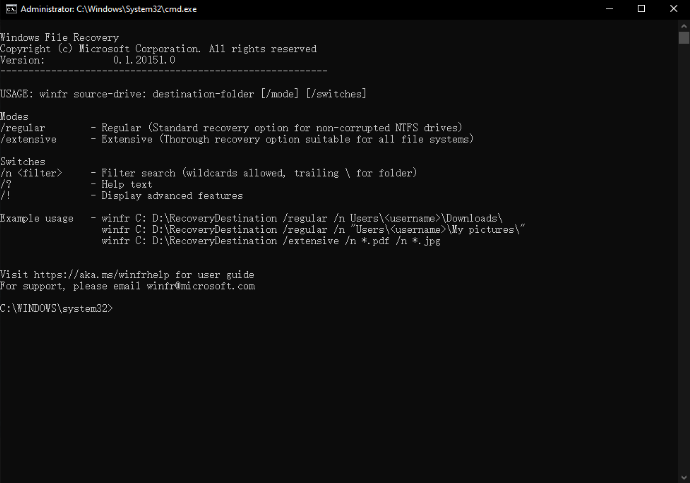
Windows File Recovery is the official data rescue software for Windows 10 version 2004 and higher and supports file systems such as NTFS, FAT, exFAT, and ReFS. With this powerful tool, you can recover deleted or lost files from different hard drives(HDDs/SSDs), flash drive and SD Card.
You can use Windows File Recovery as a command row recovery tool. Before starting data recovery in Windows, you need to specify some important parameters. These include the file system, the source drive containing the lost files, the destination directory for the recovered files, and the advanced recovery mode. Use different switches to reduce scanning time and recover deleted files. Learn more about how to use Windows File Recovery.
With this free Windows data recovery software, you can efficiently access it by following the following detailed steps after understanding the parameters.
Step 1: To recover your data, download Windows File Recovery from the Microsoft Store and install it.
Step 2: Open Windows File Recovery and then start the data recovery process.
For example, to restore a deleted PPT file in normal mode from drive D: to the driver E:, you can type as follows:
winfr D: E: /regular /n *.ppt
Step 3: Finally, you will see a folder named “Recovery_date” and “recovery_Time” in your target screen. Make sure all of your data is available.
The Windows File Recovery tool does not have a graphical user interface and works only in Windows 10 2004 edition and higher. So you need to know how the command row works. If not, try the simple and easy-to-use Windows data recovery software listed below.
Option 2: MyRecover
One of the free Windows file recovery software, My Recover has an intuitive and attractive user interface that helps you save your data by performing three simple tasks. Supports various data loss situations such as hard drive format, partition loss, virus infection, system crash error, etc.
Why choose MyRecover?
Two important scanning techniques, Quick Scan and Deep Scan, can help you find lost or deleted files and achieve a higher data recovery rate.
Seamless data recovery from various storage devices such as SD cards, HDD/SSD, external drives and USB sticks.
Efficiently retrieve data in 200+ formats, from documents to images, videos, audio files, compressed files, etc.
You can then follow these steps to recover deleted or lost files. MyRecover is free to install on Windows PCs. It is available for Windows 7, 8, 10, 11, and Windows Server.
Step 1: Use MyRecover to select the drive containing the deleted files. Select “Scan” to begin the data recovery process.
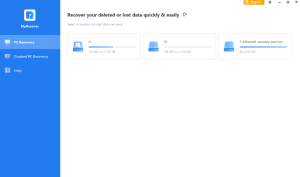
Step 2. Find all recoverable data with Quick and Deep Scan. The following window will appear. If you want to quickly find a specific file, see the filter button. Double-click to view filtered data.
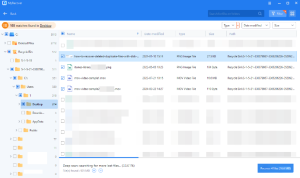
Step 3: Select the files you want to recover and click the “Recover” button to move the deleted files to a new location. Do not put them back to their original location because the space occupied by old data will be completely rewritten.
End
Use MyRecover as your best data recovery software to easily restore deleted or missing data on Windows 7, 8, 10, 11, and Windows Server. Its two key scanning techniques can find all data from devices such as hard drives/SSDs, external hard drives, flash drives, etc., and display them in the scanning window. It lays a basis of a high success rate.
If you find any data loss, from images to documents, videos, audio files, emails, etc., on your disk, consider using MyRecover if you worried about second data loss, or the types of deleted data is complicate for Windows File Recovery to handle.