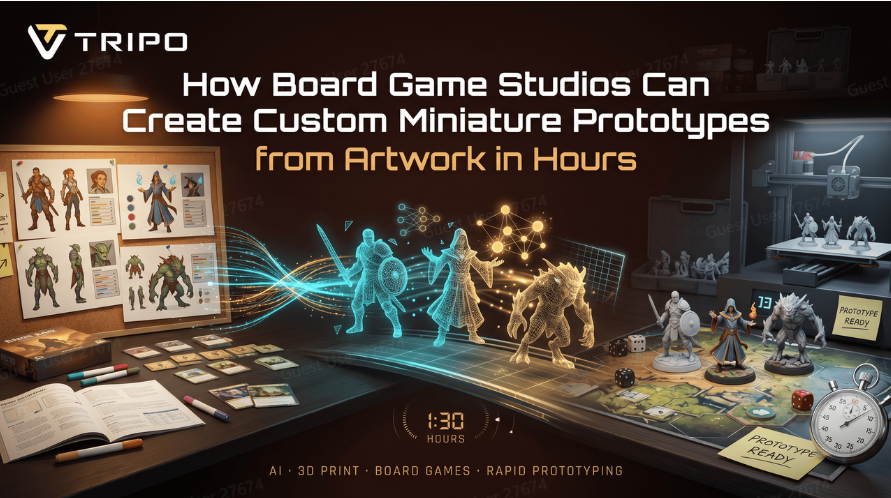
Board games today are much more than just a set of flat cardboard pieces! They have become full-fledged experiences that create worlds through incredibly detailed miniatures of heroes, monsters, even entire civilizations. These small figures serve not only as beautiful decoration but also enhance gameplay, add to the storytelling aspect of the game, and leave players with a lasting memory of the game.
The process of creating custom miniatures has historically been one of the most time-consuming elements of designing a board game – it can take weeks, even months, from initial artwork to sculpting and prototyping before finishing the miniatures. But thanks to advances in 3D Model Maker technology along with services such as Tripo 3D, studios now have the ability to produce a miniature in just a matter of hours, as opposed to months, by converting artwork into high-quality digital models of those miniatures.
With that said, let’s look at how 3D-printed miniatures are enabling game designers to go from conception to prototype faster than ever before.
When concept art deserves a seat at the game table
At the start of any miniature design is a concept.
Artists sketch powerful warriors, mythical creatures, alien civilizations, fantasy heroes and unique villains long before any board game players will ever lay eyes on them. These illustrations define the visual appearance of a game and its world.
When a studio then moves to convert these images to physical miniatures, challenges arise. A stunning illustration can tell a story and express personality and style, but transforming it into a sculpted prototype can be an arduous task.
Tripo 3D is helping bridge that gap by generating highly detailed 3D models directly from visual references, thereby shortening the time it takes to get from illustration to miniature.
Turning character sheets into physical game pieces
One of the most rewarding stages of board game development is seeing a character go from page to physical object.
Having a beloved hero, monster, or faction leader rendered as a miniature is exciting for creators and future players alike. A tangible 3D representation helps a development team assess proportions, scale, and general aesthetics much earlier than through illustrations or concept art alone.
By quickly generating a digital prototype that can be examined from all angles, Tripo 3D allows for more collaborative and productive design meetings. The ability to visualize ideas in three dimensions helps a studio’s creative decisions and design process immensely.
Making playtesting more immersive from the beginning
It’s rare for small or independent studios to be able to commission unique miniatures at the early stages of development so placeholder figures are commonly used during playtesting. However, figures that closely resemble the final product help playtesters experience the game more richly. Detailed miniatures create immersion and allow a studio to better gauge the game’s presentation from the very first tests.
By generating visuals that closely match intended final designs quickly, Tripo 3D enables the development of representative prototypes from the get-go.
Where creativity meets production speed
Board game designers need to iterate on and experiment with design elements like mechanics, rulesets, artwork and characters before finalizing the contents of a box. If a creative director, artist or developer gets a great idea for a character that could be a cool addition or modification, they’ll want to explore it quickly. A single board game might start with 50 hero concepts before finally settling on a dozen, or maybe even fewer. When developing custom miniatures for every concept that is proposed can take months, this experimentation can become prohibitively expensive and slow.
Tripo 3D allows studios to turn an image or a few images into a 3D model quickly, which encourages innovation and exploration in the early stages of development by allowing designers to rapidly develop dozens of custom miniature concepts.
Where AI-powered miniature creation delivers the greatest impact
Board game studios are discovering applications for AI-assisted modeling across many different types of games:
-
Fantasy adventure games: Designers can quickly and easily create characters, enemies, and scenery for rich, immersive campaigns.
-
Science fiction titles: Prototypes for futuristic soldiers, complex vehicles and alien worlds can be realized efficiently.
-
Collectible miniature games: Publishers can test multiple visual approaches and variations for character designs before committing to production.
-
Crowdfunding campaigns: Studios can produce compelling visual prototypes earlier in the process, which clearly articulates the product to potential backers.
In all of these applications, Tripo 3D can reduce development friction while simultaneously supporting creative freedom.
Creating more opportunities for iteration
Design is a process of continuous refinement, from mechanics to art. A studio will need to adapt character designs and artistic visions over time as game development progresses, whether that’s a tweak to a hero’s proportions or an entire redesign for a monstrous faction. Miniature generation time constraints traditionally mean that iterative improvements can’t happen quickly.
But this isn’t the case when a studio can turn around revisions on 3D models in mere hours, not weeks, from new concept art, maintaining the project’s momentum. This flexibility is crucial for games that face funding deadlines or release dates.
Bringing fantasy worlds into three-dimensional form
Artwork evokes the imagination but miniatures physically bring them to life. From hulking dragons and armored knights to alien foot soldiers and grotesque monsters, detailed 3D miniatures help players connect with and understand the world their board game takes place in.
Image to 3D workflows like Tripo 3D are helping studios transform illustrations into highly detailed 3D assets that faithfully represent the original artistic intent while allowing development to proceed at a much faster pace.
Helping artists and developers speak the same language
Artists and game designers tend to approach game development with a unique set of priorities. While an artist is thinking about storytelling, aesthetics, and visual appeal, a game designer might be thinking about scale, how a miniature will sit on a board, and any production or printing considerations.
Three-dimensional models are the universal language in these situations that makes them clear to both sides of development. Tripo 3D is streamlining communication by giving artists and designers the opportunity to view and reference a single 3D object at all stages of the process.
Image to STL has become more efficient
Traditionally, it can be a very tedious, technical process to transform artwork into STL files ready for 3D printing and prototyping. This process requires specific skills with 3D modeling software as well as considerable time.
AI-powered workflows are simplifying the process dramatically, shortening the journey from image to STL output and reducing the technical expertise required. This allows creators to focus on their game design and the player experience rather than getting bogged down with model preparation tasks.
Bringing board game worlds to life faster
While excellent miniatures have traditionally been time-consuming and resource-intensive to create, great miniatures elevate board games from fun to memorable. Tripo 3D allows studios to reduce this development friction and efficiently transform artwork into highly detailed digital models, which can be used for prototyping, communication, and production.
No matter if you’re working on fantasy adventures, sci-fi epics, tactical skirmish games or a collectible miniatures game, Tripo 3D is providing a faster way to go from illustration to miniature prototype. With the help of AI-powered 3D modeling, you can focus more on building extraordinary game worlds and less on time-consuming technical obstacles.
Ready to transform your artwork into custom miniature prototypes in hours? Start creating with Tripo 3D today and experience how AI-powered 3D modeling can speed up your next board game project.