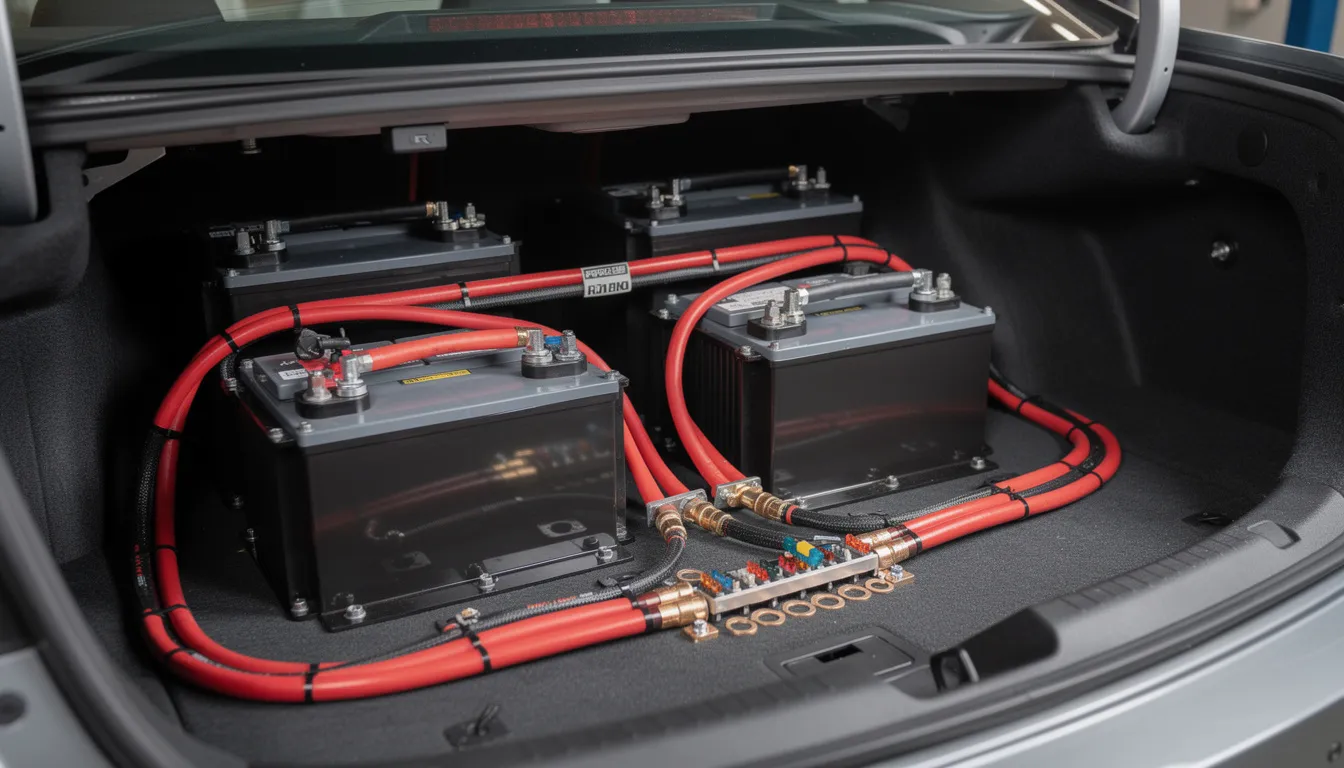
Big bass is not just about the subwoofer or the amplifier. Anyone can bolt a large monoblock amp into a car and hope for the best. The real difference between a system that plays hard for one song and a system that keeps hitting cleanly comes down to electrical support. If your voltage drops every time the bass hits, your amp is not getting the power it needs.
That is why more car audio enthusiasts are moving toward lithium battery banks for high-power systems. A properly built SCiB LTO battery bank can help stabilise voltage, support high current demand, recharge quickly, and reduce the strain caused by heavy amplifier loads. For daily bass builds, SPL systems, demo vehicles, and serious subwoofer setups, the battery is not an afterthought. It is part of the power system.
If you are building a loud car audio system, choosing the right car audio battery is one of the most important decisions you will make.
Why Voltage Drop Kills Car Audio Performance
Voltage drop is one of the most common problems in upgraded car audio systems. You turn the volume up, the bass hits, the headlights dim, and the voltage gauge falls hard. That is not just annoying. It means your amplifier is being starved of current.
When voltage drops too low, several things can happen. The amplifier may produce less clean power, distortion can increase, clipping risk goes up, and the system becomes less reliable. In extreme cases, low voltage can stress equipment, cause protection mode, or make the system sound weaker than expected.
A car audio amplifier does not create power from nowhere. It draws current from the vehicle’s electrical system. If the battery, alternator, wiring, and grounds cannot supply enough current, performance suffers. This is why a high-power car audio battery bank becomes important once you move beyond basic systems.
Why Factory Batteries Struggle With Big Bass
Factory vehicle batteries are designed mainly for starting the engine and supporting standard electrical loads. They are not designed to repeatedly feed large bursts of current to a 3000W, 5000W, 8000W, or 10000W amplifier.
AGM batteries can help in smaller to medium systems, but they still have limits. Once current demand gets serious, many bassheads find that adding more lead-acid or AGM batteries becomes heavy, bulky, and less effective than expected. You may gain some reserve capacity, but voltage stability under hard bass hits can still be an issue.
This is where SCiB LTO lithium technology has a strong advantage. LTO banks are built for high-current discharge and fast recharge behaviour, which makes them well suited to serious car audio use. They are not just about amp-hour capacity. They are about how quickly the bank can deliver current when the amplifier demands it.
What Makes an LTO Bank Good for Car Audio?
A good LTO bank for car audio needs to do three main things: supply current quickly, hold voltage under load, and recharge efficiently from the alternator.
For bass systems, current delivery matters more than simply having a large-looking battery. A weak battery with high internal resistance may sag badly under load, even if the label looks impressive. A properly matched lithium bank can respond faster to amplifier demand, which helps keep the electrical system more stable during heavy bass notes.
That voltage stability can make the system feel stronger and cleaner. Your amplifier can operate closer to its intended performance range instead of struggling every time the subwoofer pulls current.
For high-current SCiB LTO battery banks designed specifically for car audio, see Evolution Lithium�. They focus on lithium battery banks for car audio, SPL builds, daily systems, and high-current automotive power setups.
Do You Still Need an Alternator Upgrade?
A lithium bank helps support current demand, but it does not replace the alternator. The alternator is still responsible for recharging the battery bank while the vehicle is running. If your system pulls more current than the alternator can supply over time, the lithium bank will eventually discharge.
This is why alternator upgrades and lithium banks often go together. The lithium bank helps with fast current delivery during bass peaks, while the alternator helps recover and maintain the system during longer play sessions.
For a small system, a healthy factory alternator and a compact lithium bank may be enough. For real 5k, 8k, 10k, or larger amplifier setups, a high-output alternator is usually part of the conversation. The larger the amplifier, the more important charging support becomes.
A good setup is balanced. Battery, alternator, wiring, fusing, and grounds all need to work together.
Wiring and Grounding Matter More Than People Think
A strong car audio lithium battery bank will not fix poor installation. If your wiring is undersized, your grounds are weak, or your fuse placement is wrong, the system will still have problems.
For high-power car audio systems, the Big 3 upgrade is usually one of the first steps. This means upgrading the main power and ground paths in the vehicle so current can flow with less resistance. Proper cable size, secure crimped lugs, clean grounding points, and correctly placed fuses are all essential.
The battery bank should also be mounted securely and connected with suitable cable for the current demand. High-current systems are not the place for shortcuts. A poor connection can create heat, voltage loss, and reliability issues.
The best car audio battery setup is not just the battery itself. It is the full electrical path from alternator to battery bank to amplifier and back through the ground system.
What Size Lithium Battery Do You Need?
There is no single battery size that fits every system. The right lithium battery for car audio depends on:
amplifier RMS power
alternator output
listening style
demo time
target voltage range
wiring quality
number of amplifiers
whether the system is daily or SPL-focused
A 3000W daily setup has very different needs from a 10000W demo build. A system that plays short burps for SPL testing has different needs from a system that demos full songs for long periods.
As a rough rule, the higher the amplifier power, the more current reserve and charging support you need. A properly sized LTO bank can help reduce voltage drop and support cleaner amplifier output, but it should be matched to the real system, not just chosen by guesswork.
For more information on car audio lithium battery banks, SCiB cells, voltage stability, and battery sizing, visit Evolution Lithium NZ�.
AGM vs Lithium for Bass Builds
AGM batteries still have a place in entry-level and moderate systems. They are familiar, widely available, and cheaper upfront. But for serious bass builds, lithium often makes more sense long term.
LTO lithium banks offer strong discharge performance, fast recharge behaviour, and better voltage stability under heavy load. They can also reduce the need to stack multiple heavy batteries just to chase current support.
That does not mean every small system needs lithium. If you are running a mild daily setup, AGM may be enough. But once you start chasing loud bass, high RMS power, and stable voltage, a proper car audio lithium battery bank becomes a smarter upgrade.
Final Thoughts
A loud car audio system is only as strong as its electrical foundation. Big amplifiers and subwoofers need serious current support. Without it, voltage drops, amps work harder, and the system never performs at its best.
A properly built SCiB LTO lithium battery bank can help solve the problems bassheads actually deal with: voltage sag, weak bass under load, dimming lights, unstable power, and poor recovery between heavy hits. Matched with the right alternator, wiring, fusing, and grounding, lithium gives high-power car audio systems the current support they need to play harder and more reliably.
For anyone building a serious bass system, the question is not just “what amp should I buy?” It is “can my electrical system actually feed it?”