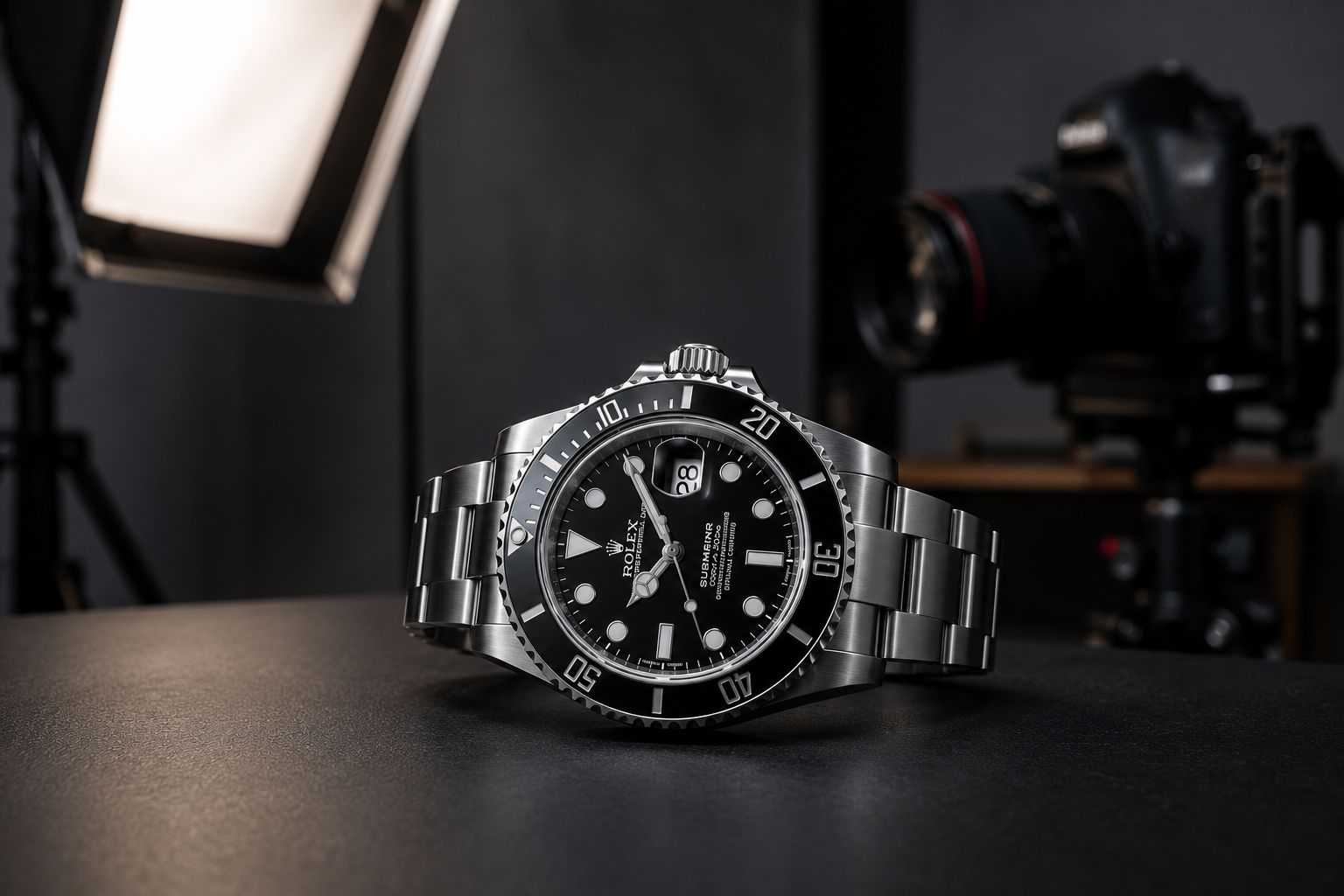
Watch photography is harder than it looks. A Rolex on a wrist or a display stand seems like a straightforward subject — small, still, well-lit. In practice, the combination of reflective metal, curved crystal, and intricate dial detail makes watches one of the most technically demanding subjects in product photography. Get it right and the result is striking. Get it wrong and you’ve got a blurry, overexposed disc that communicates nothing.
Whether you’re photographing a watch you’re selling, building a collection portfolio, or just trying to capture something you own, here’s what actually works.
The Crystal Is Your Main Problem
Everything difficult about watch photography comes back to the crystal. Sapphire is highly reflective. It catches every light source in the room, every window, every ceiling panel. And unlike a flat piece of glass, the crystal curves — which means a single light source can create multiple reflections at once, each appearing in a different part of the frame.
The solution isn’t to eliminate reflections entirely. On a modern Rolex, the crystal has an anti-reflective coating on the inner surface that reduces reflection considerably. A slight reflection at the edge of the crystal is natural and even desirable — it communicates that this is a real watch, not a render. What you want to eliminate are the hot spots: blown-out reflections that obscure dial detail or dominate the frame.
The practical approach: use a single, large, diffused light source positioned to the side and slightly above. A softbox at 45 degrees from the watch is the classic starting point. Move it until the crystal’s reflection becomes a subtle brightening at one edge rather than a bright spot across the face.
Equipment That Actually Matters
A macro lens is the right tool for watch photography. Not required — you can achieve workable results with a standard zoom — but the ability to focus closely and maintain image quality at minimum focus distance makes a real difference when you’re trying to capture the texture of a bezel insert or the detail of applied hour markers.
The 100mm macro focal length (or equivalent in crop sensor terms) is the most useful for watches. Short enough to work at a reasonable distance from the subject, long enough to compress perspective pleasingly. The natural compression of a longer macro lens makes a watch look more substantial than a wide lens at close range.
A tripod is essential if you’re shooting at studio apertures. f/8 to f/11 is where you want to be for sharp dial-to-bezel focus — deep enough to keep the whole watch sharp, shallow enough to separate it from the background. At these apertures in controlled light, shutter speeds will be slow enough to require a stable platform.
Remote shutter release or a timer delay prevents camera shake at the moment of exposure. On a mirror-equipped camera, live view or mirror lockup removes an additional source of vibration.
Background and Surface
A dark matte surface — black velvet, suede, or high-quality craft paper — works well for most watch photography. It provides contrast against the steel case and bracelet without competing for attention. Light surfaces work too but require more careful metering and tend to blow out around bright reflective elements.
The most common mistake is using surfaces with texture that shows at the scale of watch photography. A fabric with visible weave, a tabletop with wood grain, a light stand visible in a reflection — these distract from the watch. The surface should be neutral enough to disappear.
Avoid shooting watches on the wrist for portfolio or selling purposes. Wrist shooting adds variable lighting (the watch is no longer on a controlled surface), unpredictable angles, and skin tones that compete with metal for color balance. It looks casual when you want it to look considered.
How Rolex Watches Are Designed for Photography
This is worth understanding if you’re specifically shooting Rolex. The brand’s design philosophy produces watches that reward careful photography in specific ways.
The brushed and polished finishing on Rolex cases is deliberate. The case middle — the central band — is brushed horizontally. The lugs are polished on their top surface, brushed on the sides. This combination creates directional reflectivity that responds predictably to lighting: move the light and the visual weight of the case shifts. The brushed surfaces will render as matte; the polished surfaces will pick up the light source and glow.
The cyclops lens over the date — the small magnifier on the crystal — is both a challenge and an opportunity. It’s a separate curved element that reflects independently of the main crystal, creating a hot spot that can obscure the date or dominate the composition if poorly lit. Positioned correctly relative to your light source, it creates a bright point that draws the eye to the date as Rolex intended.
The ceramic bezels on modern Submariner and GMT-Master II references photograph differently than steel or earlier aluminum inserts. Ceramic is matte and holds color consistently regardless of lighting angle. The color accuracy in your final image depends more on your white balance settings than on the light direction — ceramic won’t shift color in the way that polished metal does.
Settings for Watch Photography
Start here and adjust:
Aperture: f/8 to f/11. Depth of field sufficient to keep the dial and bezel both sharp. A flat-on angle requires less depth of field than a 45-degree angle.
ISO: As low as your camera allows — 100 or 200. Watch photography rewards image quality, and noise is visible in the fine detail of a dial.
White balance: Set manually or use a grey card. Auto white balance will try to neutralize the steel, which shifts it toward blue or yellow depending on your light source. Steel should look neutral grey; gold should look warm but not orange.
Shutter speed: Whatever the metered exposure requires at your chosen aperture and ISO on a tripod. The shutter speed doesn’t matter when the camera is stable and the subject isn’t moving.
The Composition Question
Straight-on is the default. Crystal parallel to the sensor, 12 o’clock at the top, hands at roughly 10:10 (the traditional position that keeps brand text visible and creates a balanced, symmetrical composition). This is the position used in virtually all manufacturer photography for a reason: it communicates the watch completely and neutrally.
The more interesting compositions come from the 45-degree angle — roughly where you’d see the watch if you were wearing it and glanced down. This angle shows the case thickness, the relationship between the bezel and the crystal, and the bracelet in a way that flat-on shooting doesn’t. It’s also where the directional finishing on Rolex cases becomes most apparent.
Winding crown detail, bracelet clasp mechanism, caseback engravings — these are the shots that collectors want to see on pre-owned purchases. They’re also good tests of your macro technique.
One Practical Note
The best watch photography for selling purposes is honest photography. Accurate color, neutral background, sufficient depth of field to show the whole dial, and angles that reveal the bracelet and case condition clearly. A watch photographed to look better than it is creates a buyer who is disappointed when it arrives. A watch photographed accurately creates a buyer who gets what they expected.
If you’re buying pre-owned watches — particularly something like a pre-owned Rolex — the photography in a listing tells you as much about the seller as it does about the watch. Flat lighting that hides surface texture, angles that avoid showing the bracelet, crystals photographed so the scratches aren’t visible: these are flags worth noticing.
Ermitage Jewelers has specialized in authenticated pre-owned Rolex watches since 2000.