If you learn Mandarin online or work with an online Chinese teacher, you have almost certainly encountered the question at some point: what exactly is the difference between Mandarin and Cantonese, and are they the same language or two different ones? The answer is, linguistically soeaking, rather straightforward, but culturally it indeed is a bit more complicated. Understanding it properly requires separating the political framing of Chinese linguistic unity from the phonological and grammatical aspect.
The short answer is that Mandarin and Cantonese are, by any standard linguistic measure, mutually unintelligible in spoken form. A native Cantonese speaker who has never studied Mandarin cannot understand spoken Mandarin, and vice versa. The degree of spoken divergence between the two is comparable to the divergence between Spanish and Romanian — two languages that share a common ancestor and a significant proportion of vocabulary but that no informed observer would describe as dialects of the same language. The reason they are nonetheless frequently referred to as dialects in both Chinese and international discourse is primarily political rather than linguistic.
Phonologically, the differences are substantial. Mandarin has four tones plus a neutral tone. Cantonese has between six and nine tones depending on the analytical framework used, making it considerably more tonally complex. Cantonese preserves final consonant sounds, known as stop endings, that Mandarin has lost entirely. A Cantonese syllable can end in -p, -t or -k, sounds that give Cantonese its characteristic clipped, percussive quality in certain words. Mandarin syllables, by contrast, end only in vowels or in the nasal consonants -n and -ng. This difference alone produces a phonological profile so distinct that the two varieties sound nothing alike to an untrained ear.
Grammatically, Mandarin and Cantonese share the same basic subject-verb-object sentence structure and the same general principle of using particles and time expressions. At this level of abstraction, they are recognisably related. However, the specific particles used, their placement within the sentence, and numerous details of syntax differ considerably between the two. Also, when it comes to the the vocabulary overlap between Mandarin and Cantonese, a large proportion of basic vocabulary derived from the same historical source, but the pronunciation differences are very large. Additionally, Cantonese has retained a substantial number of vocabulary items from classical Chinese and from early southern Chinese dialects that Mandarin has replaced with different words entirely. Cantonese also has a significant layer of colloquial vocabulary with no Mandarin equivalent, reflecting centuries of independent development in the Pearl River Delta region.
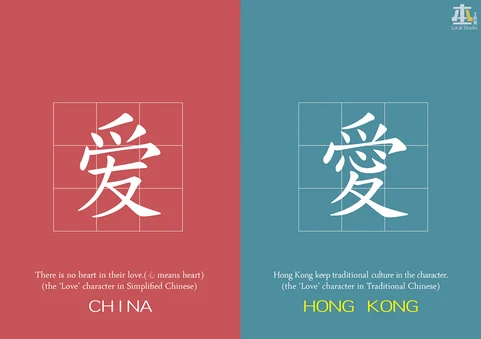
The writing system is the primary point of convergence. Both Mandarin and Cantonese are written using Chinese characters, and formal written Chinese in both communities is based on a standard literary norm closer to Mandarin grammar than to colloquial Cantonese. This means that an educated Cantonese speaker and an educated Mandarin speaker can communicate through writing even when spoken communication is impossible!
For anyone deciding which variety to study, the practical calculus is relatively clear. Mandarin is the official language of the People’s Republic of China, Taiwan and Singapore, and is the medium of instruction in schools across mainland China. It is by a considerable margin the more widely useful variety for anyone whose interests relate to China as a whole. Cantonese remains the dominant spoken language of Hong Kong and of significant diaspora communities in North America, the United Kingdom and Australia, and is the appropriate choice for anyone whose specific interests are concentrated in these communities. Some Chinese language teaching institutions like GoEast Mandarin in Shanghai focus exclusively on Mandarin instruction, however, will also build cultural awareness of regional linguistic diversity, equipping students to understand why the Chinese they hear in a Hong Kong film or a Guangzhou market sounds so different from what they have learned, and what that difference represents historically and culturally.