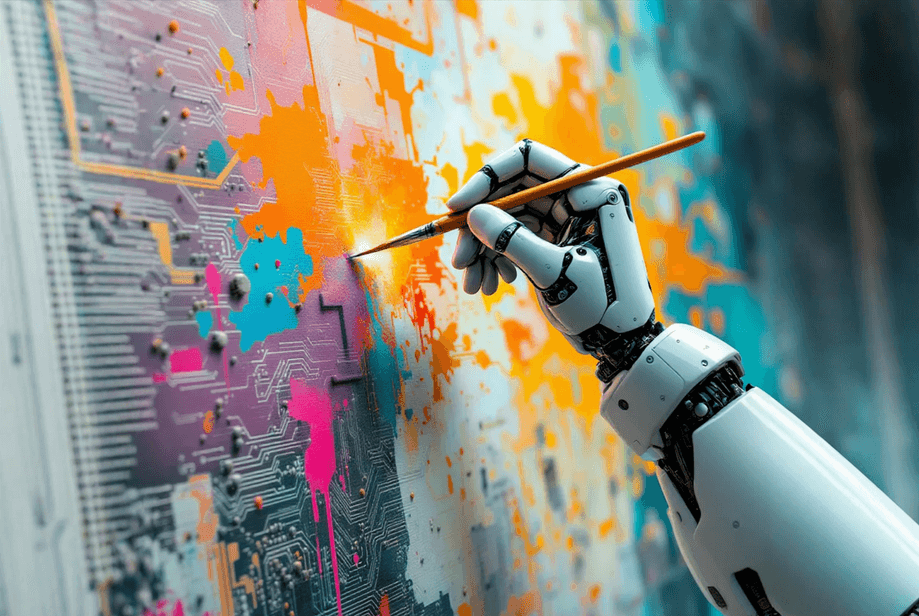
We live in a time when technology allows people to create anything they can imagine—almost. In addition to being able to create custom, stunning AI-generated wallpapers, AI technology allows companies to sell products contained in AI-generated photographs. Defining AI-generated images in this way allows us to analyze consequences of AI in this technology utilizing its efficiency to sell products with little overhead. AI-generated images can be refined to create a slick product. But AI-generated images can also conceal a value that, while possibly beneficial to the creator of the image, is ultimately detrimental to society. AI will create images that appear perfect; however, this value of perfection ultimately creates something creepy, something that, while not alive, is watching back.
This insidious technology that could allow people to sell products without the actual overhead of creating convincing photographs, themselves. AI-generated images that truly create value without the true artistic, entrepreneurial energy.
The Rise of Perfect Illusions
AI-generated images appear to be a dream. Design that previously took time, creativity, and artistic energy, AI can create the perfect image of the environment, outside of the box; abstract; it creates the perfect photograph of a made-up product. Everything becomes so fast, so cheap, and so perfect.
But with this perfection comes sacrifice.
AI-generated images are not captured, they are predicted. Everything that AI is creating must come from millions of images. Every perfect photograph of that product you admire is a predicted reconstruction of influence that is made, not a perfect drive that has the influence to accommodate beauty.
Unfortunately, in many cases, the influence is not aligned with the way it should or the way you would describe it.
When Details Start to Feel Wrong
Users are beginning to see some peculiar things. A wallpaper may look nice at first glance, but there are small details that are off; perhaps a reflection does not correspond to the source of the light, a face seen in the textures, or some patterns repeat unnaturally.
Likewise, an AI photo for products may show items in impossible situations. A watch floating without any suspension. A shadow that is oriented incorrectly. A reflection that shows something that should not be there.
These are not simply errors. Rather, they are reminders that the image itself was not real.
In the long run, these little details create an uncomfortable atmosphere. A distortion triggers the brain to sense that something is wrong, even if a person cannot put a finger on it.
The Illusion of Trust in Product Imagery
For companies, AI generated images of products are a game changer. Businesses can present items in a luxurious environment or create seasonal themes, all while ensuring the visuals are of the same high quality across the entire catalog.
But that is where the thriller aspect comes in – what happens when people can no longer distinguish the real from the fake?
AnAI photo for products can present an item in an impeccable way, while concealing all the flaws that, in a real photo, would be visible. Illumination can be heightened to an extent that it looks unreal. Textures can be completely removed. Hues can be altered to any preference.
What is the end result? A product that, paradoxically, exists more in the digital realm than it does in real life.
There is latent stress created by expectation and reality discrepancies. What is disappointing and falls short of expectations is something customers will lose confidence in. Once it is gone, customers will not trust the product, regardless of its visually appealing qualities.
Wallpapers That Feel Alive
Artificial intelligence wallapapers that are meant to inpsire, calm, or motavate customers. Users claim to feel a strange feeling as though these wallpapers are alive.
There is a forest wallpaper that has shadows that do not seem to fall in the exact way. A city wallpaper where the windows glow differently each time you see it. Even abstract wallpapers seem to have hidden faces and figures.
This is not post-mortem. This is just a testimony to the many visual cues processed by Aritifical intelligence and then omitted in the image produced. Humans are pre-disposed to see patterns, especially those associated with motion.
When those patterns are not present, and the intentionality is, then a situation is created where it is better to feel strange.
The wallpaper hasn’t altered itself, rather it is, as a result of the person wallowing in a strange feeling of immense tension as thrill begins.
The Power Behind the Screen
Artificial intelligence is not a random process. Data is the determinant, and every generation of product photos relies on the previous generation.
What if this data, however, is flawed by biases, gaps, or occult patterns?
Undoubtedly, the artificial intelligence is creating something by these means. A product image could, for example, the lighting could be in such a way as to misrepresent the reality of the product. A wallpaper, perhaps, is a by product of cultural or visual spontaneous generation.
These influences will shape societal standards of what is normal and beautiful. This makes it difficult to discern new ideas born of human inspiration and ideas produced by programs.
Creating mass content with these algorithms means creating a new form of media under the control of the algorithms.
Is the Future Beautiful or Deceptive?
AI is changing visuals as we know it. The degree to which an image-generating algorithm will allow a business to operate is solely reliant on the advancement of these algorithms. AI photos for products will help businesses scale faster and ai generated wallpaper will help designers create a more immersive experience.
We need to ask how much we can trust what we see.
Authenticity is precious as we move further into advanced illusion technologies. Businesses and individuals need to let go of the illusion that it’s an either/or scenario to find an authentic and efficient way to do things.
The danger is not the illusion.
It is that we may not question it.
Conclusion
AI has brought us speed and precision in a new visual era of extensive creativity. But with it an undercurrent of tension. No matter how beautiful a product image is it will always be true that it was never real.
Moving forward, tension is our only form of defense and we should be appreciative of it. Beauty should be met with a critical eye.
Sometimes, the most beautiful image is the one that is utterly vacant.